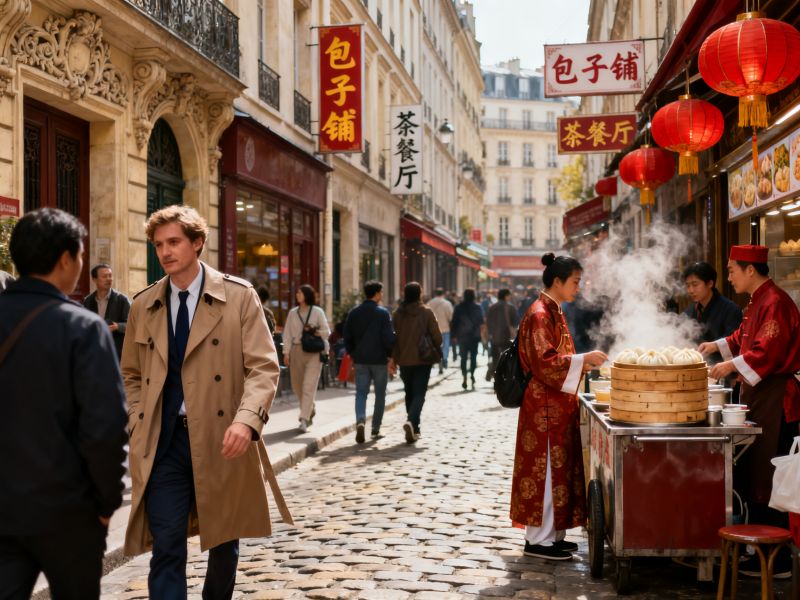
On Rue de Belleville, a hand-painted sign reads “Traiteur Chinois – Spécialités de Wenzhou” in faded gold letters. The shop opens at 6 a.m., and by seven, a line of elderly Chinese immigrants clutching reusable bags waits for steamed buns and soy milk. This is not the Paris of postcards. It is the working heart of the New Paris Chinese community—a population that has grown from a few thousand in the 1970s to an estimated 600,000 across the Île-de-France region, according to INSEE data. Walk three blocks and you’ll hit a Franco-Chinese hair salon, a remittance office, and a grocery store selling bok choy next to Camembert. The density is no accident. Chain migration from Zhejiang province。particularly Wenzhou, built these networks brick by brick.I spent a Tuesday afternoon with Li Wei, who runs a wholesale textile stall in the Sentier district. “My father arrived in 1985 with two suitcases and a debt” he told me, sliding a stack of invoices across a scratched counter. “Now we supply forty boutiques” Li’s story mirrors the broader economic shift: New Paris Chinese entrepreneurs have moved beyond restaurants and leather goods into tech repair, real estate, and logistics. A 2022 Chamber of Commerce report noted that Chinese-owned businesses in Paris generated €4.8 billion in annual revenue。with 38% operating in sectors outside traditional niches. That’s not just assimilation—it’s strategic diversification. The Sentier’s narrow streets, once dominated by Jewish textile merchants, now buzz with Mandarin and French Creole, a linguistic mash-up you won’t find in any guidebook.
Yet the community faces friction. In the 13th arrondissement’s Olympiades complex, residents have complained about overcrowded apartments and illegal subletting. Municipal raids in 2021 uncovered 200 units housing up to six people per studio. “People see the crowding and assume the worst” says Zhang Min, a social worker with Association Pierre Ducerf. “But these are families doubling up to afford rent。not criminal networks” The stereotype of the “Chinese mafia” lingers in French media, despite crime statistics showing lower offense rates among Chinese nationals than the national average. I watched a city council meeting where a local official suggested “cultural integration courses” for Chinese shopkeepers—a proposal that sparked quiet outrage. “We’ve been here thirty years” one woman muttered in Mandarin. “When do we stop being ‘new’”Generational divides cut deeper than any external prejudice. Second-generation New Paris Chinese—many born in France—navigate a hyphenated identity. Kevin Tan, 24。manages his parents’ pho restaurant in Belleville but codes apps on the side. “My father thinks I’m lazy because I don’t wake up at 5 a.m.” he laughed. “I think he’s stubborn because he won’t use a delivery app” Tan’s startup, a WeChat-based booking platform for Asian eateries, already has 120 clients. Meanwhile, cultural preservation efforts are flourishing: the Chinese New Year parade in the 13th arrondissement now draws 200,000 spectators, and a new bilingual school opened in 2023 with a waiting list of 400. The tension between tradition and reinvention isn’t unique to this community—but it’s especially visible when your parents’ grocery store sits next door to your crypto startup.What strikes me most is the quiet pragmatism. No grand manifestos。no performative activism. Just a relentless focus on the next generation’s footing. At a Saturday Mandarin class in a cramped basement, I watched kids ages six to twelve recite Tang dynasty poems before switching to French for a geometry worksheet. Their teacher, a 58-year-old former accountant from Shanghai, told me, “They need both. One language for home, one for the bank” That duality—the New Paris Chinese experience in miniature—resists easy labels. The community isn’t assimilating into a melting pot;
it’s building a parallel structure, with its own banks, media, and political lobbies. Whether that structure enriches or fragments Paris depends on who you ask. But on Rue de Belleville, the line for steamed buns grows longer every year.